How to Check Home Water Pressure in Lake Forest, CA (and Why 80 psi Matters)
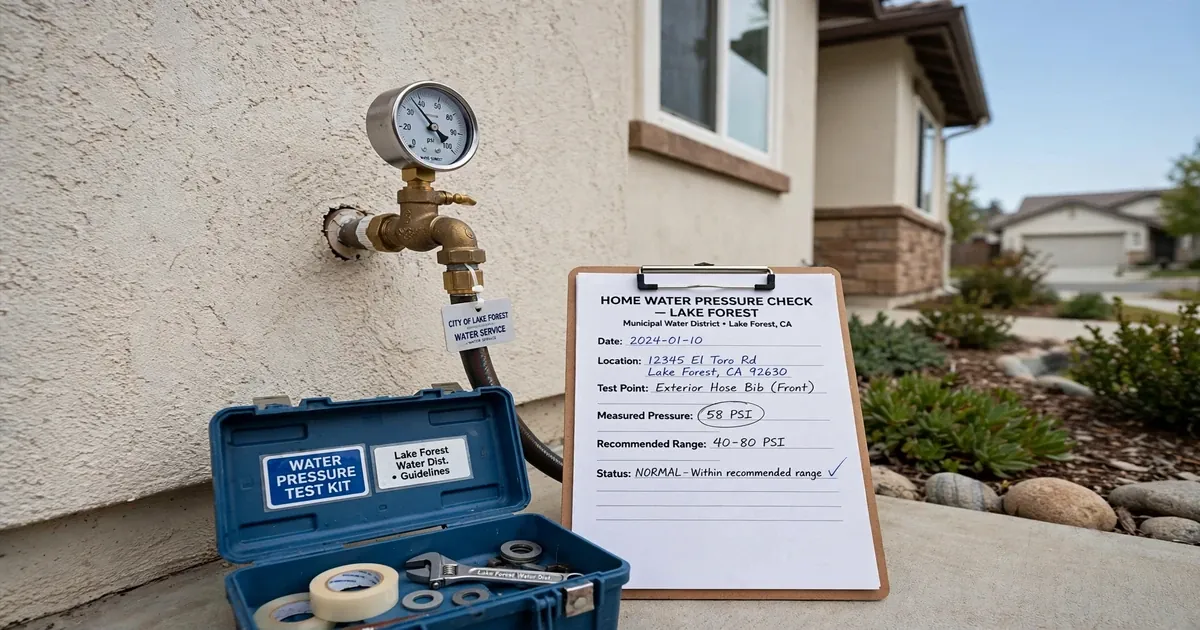
Screw a pressure gauge onto an outdoor hose bib, make sure no water is running in the house, and read the dial. Between about 40 and 80 psi is the normal range, and the California Plumbing Code requires a regulator when pressure would exceed 80 psi. A reading above 80 stresses pipes, fixtures, and water heaters, and it is a common reason supply lines fail.
How to Test Your Water Pressure
Buy a gauge
A pressure gauge with a hose fitting is inexpensive at any hardware store.
Turn off all water
Stop the washer and dishwasher, and make sure no one is using water.
Attach it to a hose bib
Screw the gauge on the outdoor faucet nearest the main and open the faucet fully.
Read the dial
Note the reading. Test again at night, when pressure is often higher.
What the Reading Means
| Reading | What it means | What to do |
|---|---|---|
| Under 40 psi | Low pressure | Check for a partly closed valve, a clogged filter, or a buried line problem |
| 40 to 80 psi | Normal range | No action needed |
| Over 80 psi | High pressure | Have the regulator tested or installed |
| A reading that climbs after fixtures close | Possible regulator failure or thermal expansion | Have a plumber check the regulator and expansion control |
Why 80 psi Is the Line
The California Plumbing Code, which is built on the Uniform Plumbing Code (UPC), requires a pressure regulator where static pressure exceeds 80 psi. The reason is wear. High pressure pushes harder on every joint, valve, and appliance, and it shortens the life of water heaters, toilets, and washing machine hoses.
The damage is slow and then sudden. A supply line that has been stressed for years can fail all at once. That is why a pressure check belongs in the same category as testing your smoke alarms. For what happens when a line lets go, see what happens when a pipe bursts.
Why Hillside Streets Can Run High
Water pressure rises as elevation falls. A house sitting well below the street or on the lower side of a slope has more water pushing on it than one near the top. Lake Forest and the hills of Portola Hills and Foothill Ranch include enough change in elevation that pressure can differ a lot from one street to the next.
That is a reason to test, not a reason to worry. Homes on a hillside such as Portola Hills are common candidates for a regulator, and a plumber can install or adjust one in a short visit.
Signs a Regulator Is Failing
A regulator is a mechanical part that wears out. These are the signs.
- Banging pipes when a valve closesThis is water hammer, and high pressure makes it worse.
- Toilets that run or fill noisilyFill valves wear faster under high pressure.
- Leaks at the water heater relief valveHigh pressure and thermal expansion can open it.
- A gauge reading above 80The simplest sign of all.
- Faucets that spit or hissPressure surges can show at the tap.
Regulators, Expansion Tanks, and Old Pipes
A regulator reduces incoming pressure, and an expansion tank gives heated water somewhere to go. Many homes need both, and they work together. If your system has a check valve on the incoming line, thermal expansion cannot back up into the street, and an expansion tank becomes more important.
A regulator also protects old piping. If pressure has been high for years and the house has aging copper, the pipes may be thin in places. Ask the plumber about the condition of the system, and consider replacing the supply pipes if leaks are recurring.
What to Expect When a Regulator Is Replaced
Water is shut off
The plumber closes the main and drains the nearby pipes.
The old regulator comes out
It is cut or unscrewed from the line near the main shutoff.
The new one goes in
It is set to a safe pressure, often in the middle of the normal range.
The system is tested
The plumber checks pressure at a hose bib and looks for leaks at the new fittings.
Pressure and the Water Heater: The Expansion Tank Question
When a water heater heats water, the water expands. In an older system, that extra volume pushed back into the street. Many homes now have a check valve or a regulator that blocks it, so the pressure has nowhere to go. It rises inside the house and can open the relief valve on the heater or stress the tank.
An expansion tank absorbs the extra volume. It is a small tank with an air cushion, installed on the cold line near the heater, and it needs to be sized for the system and set to the right pressure. A dripping relief valve on a heater is a common sign that the expansion control is missing or has failed.
Ask for a check of the expansion tank whenever the heater is serviced or replaced. See replacing a water heater for how it fits into a new installation.
Low Pressure: Where to Look
Low pressure has simpler causes than high pressure, and most can be found in an afternoon.
- Is it one fixture or the whole house?One slow fixture usually has a clogged aerator or cartridge.
- Is the main valve fully open?A partly closed valve restricts flow.
- Is the regulator failing?A worn regulator can also reduce pressure.
- Does the meter move with everything off?A leak on the buried line can drop pressure.
- Are pipes old and corroded?Galvanized pipe narrows from the inside over decades.
When to Test Again
Test pressure once a year, and again after any plumbing work that touches the main line. Test after a new regulator is installed, after a water heater replacement, and before you buy a home. Write the reading and the date on a label near the main shutoff.
A reading that changes from one test to the next tells you something. A steady 60 is fine. A reading that creeps up between tests may mean the regulator is failing, which is worth a plumber's look before a supply line gives out.
Choosing and Reading a Gauge
Pick a gauge with a range that suits household water, such as zero to 100 or 200 psi, and a hose-thread fitting. A liquid-filled dial is easier to read because the needle does not jitter. Some gauges have a second pointer that holds the highest reading, which is useful for catching the overnight peak without staying up to watch.
Leave the gauge on the hose bib for a day if it has a peak pointer, then note the high and the low. A wide swing between the two points to a regulator that is not holding steady. Remove the gauge afterward, since leaving it under constant pressure shortens its life.
Water Pressure Questions
Many regulators have an adjustment screw, but a worn one cannot be set reliably. A gauge on a hose bib shows whether your adjustment worked.
Anywhere in the normal range works. Many homeowners prefer the middle of the range for comfort and equipment life.
Check for a partly closed main valve, a clogged filter or aerator, or a leak. A buried line leak is covered under buried water line repair.
It is a modest repair compared with a flooded kitchen. A plumber can quote a price after testing.
Yes. It often rises at night when demand falls, which is why testing at night shows the highest reading.
Plumbing Problem Right Now?
Call the 24/7 line. The price is quoted before work starts.
Call (949) 325-3122Service Area Map: Lake Forest, Foothill Ranch, Portola Hills
The map shows the Lake Forest area we dispatch to, including ZIP codes 92630, 92610, and 92679.